
USE CASES
Where MarKomX fits in your week.
The four walls every SME owner hits — visibility, expertise, consistency, trust — don't live in isolation. They show up on Monday morning, in the gap between the work you planned to do and the marketing you didn't get to. This page shows what MarKomX looks like when it steps into that gap.
You've seen the four walls on the home page. Here's what happens when a team walks through the door with you.
These are need-based scenarios — the situations we see most often when we talk to Swiss and Italian SMEs. The needs are real; the companies are deliberately generic. If you recognise your situation in one of them, that's the point.
Each scenario shows which MarKomX agents are involved, what they do, and what changes for the business. The numbers are framed as typical or expected outcomes, not as guarantees. We don't promise results we haven't earned yet — we show you the shape of the value.
PROOF, NOT PROMISES
Work we've already delivered.
The scenarios below are need-based. The examples here are fact-based. Each one is actual work the MarKomX team produced for the Ai-Fi launch and for customer acquisition campaigns. Not hypothetical. Not "imagine if." Delivered.

01
EU AI Act Sprint — Turning Regulation into a Lead Gen Campaign
When the EU AI Act transparency obligations approached (2 August 2026), the team identified the regulatory change as a market opportunity for Italian SMEs. Instead of just writing about it, we built a full multi-channel campaign in Italian.
CAPABILITIES USED
Intelligence · Content · SEO & GEO · Email · Web
What was delivered:
- A 22-keyword SEO cluster for "AI Act marketing PMI" terms
- Two blog articles in Italian (~3,000 words each, SEO-optimised)
- A lead-gen landing page (/ai-act-ready-pmi) with a free readiness checklist
- A 6-slide LinkedIn carousel in Italian
- A 3-touch email nurture sequence
- A 30-minute diagnostic consultation offer
Result: A regulatory threat turned into a 7-deliverable customer acquisition campaign — in native Italian, not translated.

02
Competitor Battle Card — Winning Head-to-Head Against Italiaonline InRete AI
The sales team needed to win deals against Italiaonline's InRete AI. The competitor analyst produced a comprehensive battle card comparing MarKomX against InRete AI across 15+ dimensions: pricing, capabilities, target customer, weaknesses, and objection-handling.
CAPABILITIES USED
Intelligence · Sales Support
What was delivered:
- Competitor battle card (29KB, 15+ comparison dimensions)
- Exact scripts for handling the most common customer objections
- Pricing comparison and positioning recommendations
Result: The sales team has everything they need to win head-to-head deals — no preparation needed before a sales call.

03
Lead Gen Sprint — 50 Lausanne/Vaud Prospects with Full Contact Details
The team ran a lead generation sprint targeting SMEs in the Lausanne/Vaud region. Two agents (Market Expert + Competitor Analyst) worked in parallel, each producing 25 prospect profiles with full contact details and outreach recommendations.
CAPABILITIES USED
Lead Generation · Intelligence
What was delivered:
- 50 curated prospect profiles with company name, contact person, email, LinkedIn, industry, company size, and relevance score
- Recommended outreach approach for each prospect
- Customer persona documents with behavioural insights for Swiss Romandie SMEs
- Sprint 2 shortlist for the next round of outreach
Result: A ready-to-use sales pipeline of 50 qualified prospects, researched and scored in a single sprint.

04
Adaptive Presentation Framework — Interactive Sales Deck
For MarKomX sales conversations, the team built a full interactive HTML presentation deck — not a static slide deck, but a navigable framework that adapts to the audience. A diagnostic poll on slide 2 branches into the relevant sections (Strategy, Content, Leads, Analytics), with persona-specific close slides.
CAPABILITIES USED
Sales Support · Visual & Creative
What was delivered:
- Interactive HTML presentation deck (2,400+ lines)
- Facilitator guide (how to run the meeting)
- One-page cheat sheet (quick reference during the meeting)
- Executive summary presentation (4 versions, investor-ready)
Result: A sales deck that adapts to the prospect in real time — not a one-size-fits-all presentation.

05
MarKomX Brand Identity — Complete System from Scratch
For the MarKomX product launch, the team built a complete brand identity from scratch — strategy, visual direction, logo system, tagline, and guidelines. The work included 3 visual direction proposals, 3 logo creative directions, and a full brand identity document.
CAPABILITIES USED
Brand Management · Visual & Creative
What was delivered:
- Brand identity document (300+ lines) covering positioning, archetype, tone, tagline
- Logo system: 10 SVG files + 14 PNG derivatives (horizontal lockups, icons, app icons, favicons)
- Tagline: "your idea set free" — approved by CEO
- Visual direction: Swiss Editorial (ivory, Fraunces + Inter, teal accent, no gradients)
- Living brand guidelines document covering voice, tone, colours, typography, usage rules
Result: A complete, production-ready brand identity system — 24 logo files, full guidelines, ready for website and print.

06
PR Launch Kit — 43 Journalist Contacts + 5 Pitch Templates in 3 Languages
For the MarKomX PR launch, the team produced a complete PR kit — outreach strategy, journalist contact list, pitch templates in 3 languages, and interview prep. The journalist list covers Swiss Romandie, Swiss Italian, Italian national, and Swiss national publications.
CAPABILITIES USED
PR & Media Relations · Content
What was delivered:
- Outreach strategy defining narrative, angles, target publications, and cadence
- 5 pitch templates in French, Italian, and English, tailored to different journalist beats
- 43 journalist contacts with beats, outlets, emails, and recent article notes
- Interview prep kit with talking points, likely questions, key messages, and dos/don'ts
Result: A ready-to-execute PR campaign with everything the CEO needs to get press coverage — no agency required.
01 — VISIBILITY
"My competitors are everywhere online. I'm invisible."
Being invisible isn't a talent problem. It's a production problem. Here's what happens when production becomes someone else's job.
When your expertise doesn't show up on Google
The need. A Swiss precision engineering firm makes components for medical devices. The quality is exceptional — trusted by hospital suppliers for two decades. But when a procurement manager searches "precision machining Switzerland" on Google, the company doesn't appear in the first three pages. Competitors with smaller workshops and newer equipment own the top results. The owner knows this is happening. He also knows he doesn't have the time, the skills, or the inclination to write about precision engineering on a website every week. He tried, twice. Both times, the blog went quiet after three posts.
How MarKomX answers. The SEO expert agent runs a technical audit of the existing website — page speed, structured data, keyword gaps, crawlability. The copywriter agent produces a quarterly content calendar of long-form articles targeting the search terms procurement managers actually use: "CNC precision machining Switzerland," "medical device components Switzerland," "ISO 13485 machining partner." The social media manager agent repurposes each article into a LinkedIn post for the company page. The Marketing Director reviews every piece against the brand guidelines before publication and coordinates with the owner's technical team for fact-checking. The cadence is fixed: two articles per month, one LinkedIn post per week, one quarterly SEO review.
The outcome. Within four to six months, the company typically appears on the first page of Google for three to five of its core service terms. LinkedIn impressions grow from a few hundred per post to several thousand. The owner stops worrying about Google. He reviews the monthly performance report — which pages are ranking, which posts are driving traffic, which enquiries came through the website — and goes back to running the workshop. The marketing is happening whether he's in the room or not.
"We didn't need to become a content company. We needed to be findable when someone was looking for us."
When your hospitality brand is invisible on Instagram
The need. A family-run hotel group in Italian-speaking Switzerland has beautiful properties and loyal repeat guests. But on Instagram, the account has a few hundred followers and posts once a month, usually a photo of a sunset with no caption strategy. Competitors — newer, smaller properties with dedicated social media managers — have thousands of followers and consistent engagement. The group's marketing consists of a receptionist posting when she has a moment. The general manager knows Instagram matters for hospitality bookings, especially for international guests who discover the region through the platform. She doesn't know what to post, when to post, or how to make it consistent across properties with different personalities.
How MarKomX answers. The social media manager agent builds a content architecture for each property — a distinct visual identity and posting rhythm that matches the property's character. The copywriter agent writes captions in three languages (Italian, German, English) that tell the story of each property. The art director agent produces a monthly visual plan — photo themes, reel concepts, story templates — that the properties can shoot with their phones. The data scientist agent tracks engagement per property, per post type, per language, and adjusts the calendar monthly. The Marketing Director reviews everything for brand consistency across the properties and ensures the visual identity stays cohesive.
The outcome. Within three months, the group typically reaches several thousand engaged followers, with reach growing 5–10x compared to the pre-MarKomX baseline. Direct booking enquiries through Instagram DMs begin arriving weekly. The receptionist stops being the de facto social media manager. The general manager reviews a monthly dashboard — followers, reach, engagement rate, booking enquiries — and knows the brand is visible to the people planning their next trip.
"We have properties and stories. MarKomX gave us one team to tell all of them — consistently, in the right language, on the right channel."
When your B2B company has no LinkedIn presence
The need. A mid-sized B2B SaaS company develops workflow automation software for logistics companies. The product is strong. The sales team is strong. But when a logistics director searches for "warehouse automation software" on LinkedIn, the company is nowhere. The CEO posts occasionally — a conference photo, a product update — but there's no cadence, no strategy, no content architecture. The competitors are everywhere: thought leadership posts, customer stories, product demos, industry commentary. The company looks smaller and quieter than it actually is. The sales team hears "I couldn't find you on LinkedIn" in pitch meetings. That's a trust problem before the conversation even starts.
How MarKomX answers. The Marketing Director agent builds a LinkedIn strategy with three content tracks: thought leadership (the CEO and CTO's perspectives on logistics automation), product education (how the software solves specific workflow problems), and company culture (what it's like to work there, why the team is worth trusting). The copywriter agent drafts posts in German and English, calibrated to the logistics director persona. The social media manager agent schedules the calendar — three posts per week across the company page and the CEO's personal profile. The data scientist agent tracks impressions, engagement, and — critically — inbound connection requests from target accounts. The Marketing Director reviews every post for tone and factual accuracy, and coordinates with the CEO for personal-profile posts that need his voice.
The outcome. Within six months, the company typically grows LinkedIn impressions from a few thousand per month to tens of thousands per month, with a measurable increase in inbound connection requests from target accounts. The sales team stops hearing "I couldn't find you on LinkedIn." The CEO spends 30 minutes per week reviewing scheduled posts and approves them in one batch. The company looks — online — exactly as competent as it is in person.
"We were losing deals before the first call. Not because the product wasn't good — because the buyer couldn't find us."
02 — EXPERTISE
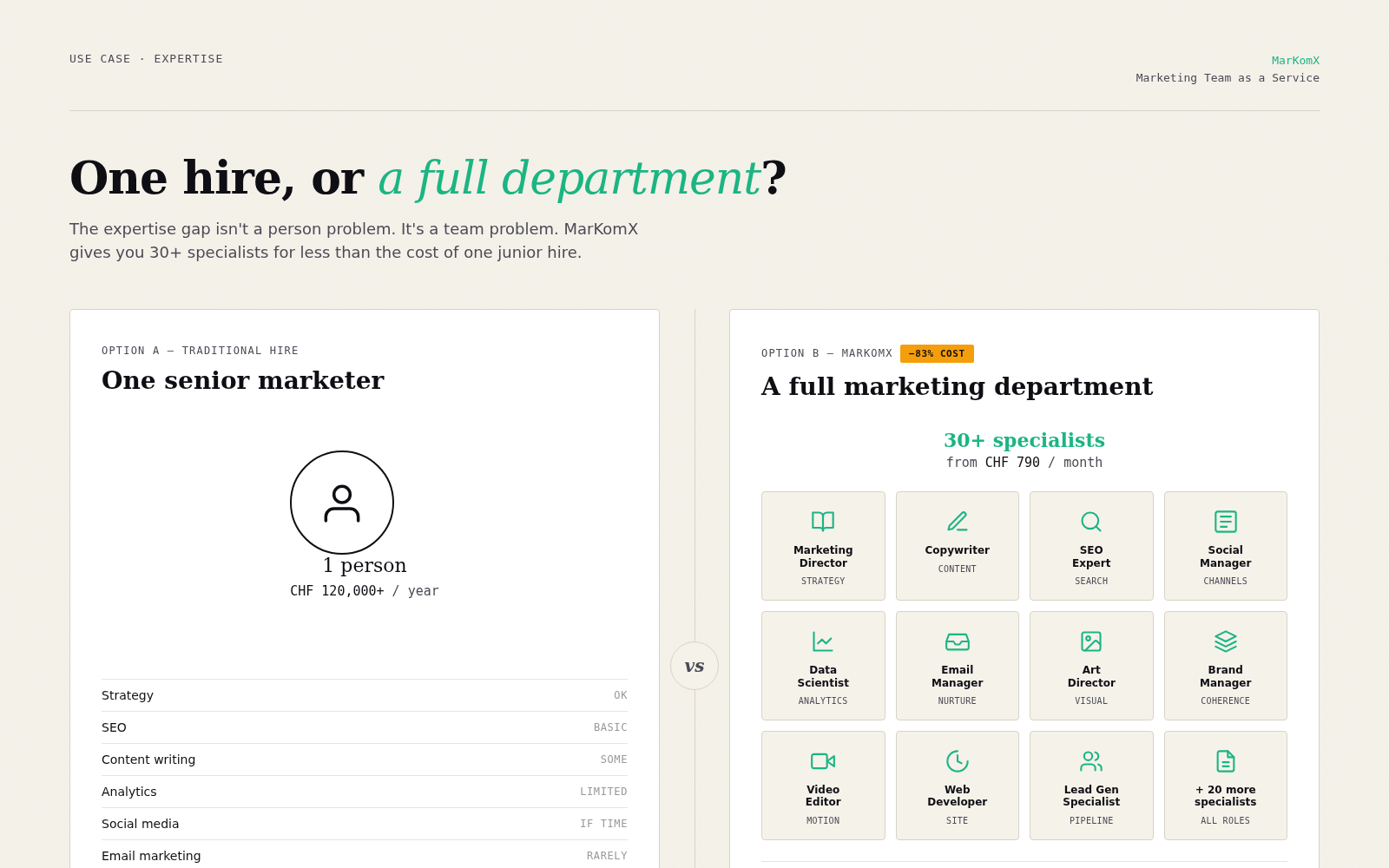
"I can't afford a full marketing team. A senior marketer costs CHF 120K+."
You don't need to hire a team. You need to use one. Here's what that looks like when the team is already assembled.
When you need a marketing department overnight
The need. A fintech startup in French-speaking Switzerland has just closed a funding round. The product is live, the first customers are onboard, and the board wants to see a marketing function — strategy, content, SEO, social, analytics, lead generation — operational within the quarter. The CEO has a budget for one senior marketing hire. One. A senior marketer costs CHF 120K+ per year. That's one person, doing everything badly, with no specialised skills in SEO, content, analytics, or social. The CEO doesn't need one person. He needs a department. He has budget for one person. The gap between what the board expects and what one person can deliver is the gap that will kill the company's growth trajectory.
How MarKomX answers. The Marketing Director agent builds the marketing strategy in week one — positioning, messaging architecture, channel mix, 90-day roadmap. The copywriter agent produces the foundational content: website copy refresh, three pillar articles, an investor narrative, a sales deck script. The SEO expert agent runs a technical audit and a keyword strategy for the Swiss fintech market. The social media manager agent launches the LinkedIn company page with a six-week content calendar. The data scientist agent sets up the analytics stack — GA4, dashboard, KPI tracking — and builds the monthly reporting template. The email marketing manager agent designs the onboarding sequence for new sign-ups. Everything is coordinated by the Marketing Director, reviewed against brand guidelines, and delivered through a single MarKomX subscription.
The outcome. The CEO gets a full marketing department — Director, brand, content, SEO, analytics, social, email — for less than the cost of one junior hire. The board sees a marketing function operational within 30 days, not 90. The CEO spends two hours per week with the Marketing Director (review call, approve direction, provide product input) and zero hours managing individual specialists. The company's monthly marketing spend is transparent and fixed — no surprise hires, no tool subscriptions to manage, no onboarding costs when the next specialist is needed.
"We had budget for one person. We needed a department. MarKomX gave us the department."
When you can't find a trilingual marketer
The need. A mid-sized industrial equipment manufacturer in French-speaking Switzerland sells to customers across Switzerland, Germany, and Italy. Their marketing needs are specific: technical product documentation in German, sales collateral in Italian, corporate communications in French, and a LinkedIn presence in English for the international logistics audience. They've been looking for a senior marketing manager who is fluent in all four languages, understands industrial sales cycles, and can produce content across all of them. They've been looking for months. The role is still open. In the meantime, the commercial director is writing the Italian collateral himself — badly, on Sunday evenings — and the German product sheets are being translated by an external agency at a premium per word with a five-day turnaround. The cost is adding up. The quality is inconsistent. The brand voice doesn't exist.
How MarKomX answers. The Marketing Director agent builds a trilingual content architecture — one brand voice, three language tracks, each with native-quality copy. The copywriter agent produces French corporate content, German technical content, and Italian sales collateral in parallel, each reviewed by the brand manager agent for tone consistency across languages. The SEO expert agent optimises each language track for its respective market — German search behaviour differs from Italian, which differs from French. The social media manager agent runs three LinkedIn tracks (FR, DE, IT) with a shared content calendar. The translation agency contract is ended. The commercial director gets his Sundays back.
The outcome. The manufacturer gets trilingual marketing — French, German, Italian, plus English for international — through a MarKomX subscription that costs less than the combined cost of the agency translation contract and the open marketing manager salary they were trying to fill. Content ships in all three languages every week. The brand voice is consistent across markets for the first time. The open role is closed — not by hiring, but by subscribing.
"We spent months looking for one person who could do everything. MarKomX gave us a team where each person does one thing — and does it in the right language."
03 — CONSISTENCY
"Marketing works for two weeks. Then I get busy and it stops."
The problem isn't your discipline. The problem is that marketing shouldn't depend on you. Here's what a team that doesn't forget looks like.
When you've restarted marketing four times
The need. A management consultancy in French-speaking Switzerland has restarted its marketing four times in two years. Each restart follows the same pattern: the partner declares "this time we'll be consistent," they plan a content calendar, they publish two articles and four LinkedIn posts, and then a client engagement gets intense and the marketing stops. Three weeks of silence becomes six weeks becomes three months. When they restart, they start from zero — no audience momentum, no SEO authority, no cadence to return to. The partners are frustrated, not because they don't understand the value of marketing, but because the value of marketing always loses to the urgency of client work. The consultancy is excellent. Nobody outside the existing client base knows.
How MarKomX answers. The Marketing Director agent builds a realistic content cadence — one article per fortnight, two LinkedIn posts per week — calibrated to the partners' actual availability, not to an aspirational schedule. The copywriter agent interviews each partner for 30 minutes per month and turns their thinking into articles in their voice. The partners review drafts, not blanks — they're editing, not writing. The social media manager agent schedules the LinkedIn calendar two weeks in advance. The Marketing Director enforces the cadence: if a partner misses an interview, the copywriter drafts from their previous thinking and sends it for review. The marketing doesn't stop when client work gets intense. It also doesn't demand more than 30 minutes per partner per month.
The outcome. The consultancy publishes 24 articles per year and 100+ LinkedIn posts — consistently, not in bursts. Over 12 months, the firm typically sees LinkedIn impressions grow from near-zero to the tens of thousands per month, with inbound enquiries from target clients beginning around month four. The partners stop feeling guilty about marketing. They show up for their 30-minute interview, review the drafts, and go back to client work. The cadence holds.
"We didn't have a marketing problem. We had a 'marketing depends on us' problem. MarKomX took us out of the critical path."
When you can't maintain a blog
The need. A legal practice in Bern specialises in corporate law for Swiss SMEs. The senior partners know that a regularly updated blog — explaining regulatory changes, court rulings, and compliance requirements in plain language — would build authority and drive enquiries. They've started a blog three times. Each time, the first post goes up in January. The second post goes up in February. By April, the blog is silent. By July, it's embarrassing — a visitor sees a blog that was last updated five months ago, which is worse than no blog at all. The issue isn't knowledge — the partners are the experts. The issue is that writing a 1,500-word legal explainer in plain French takes a partner four hours, and four billable hours per week is significant opportunity cost. The math doesn't work.
How MarKomX answers. The copywriter agent interviews the relevant partner for 20 minutes per article — the legal substance, the key implications, the practical advice for SME clients. The copywriter drafts the article in plain French (or German, or English), calibrated to the SME owner persona, not the legal peer audience. The partner reviews the draft for accuracy (45 minutes), requests revisions, and approves. The SEO expert agent optimises each article for the search terms SME owners use ("nLPD compliance Switzerland," "share purchase agreement template," "GDPR vs nLPD"). The social media manager agent posts each article on LinkedIn with a hook that leads the reader to the full piece. The Marketing Director coordinates the monthly calendar and ensures the cadence — two articles per month — holds even when the partners are in trial.
The outcome. The practice publishes 24 legal explainers per year — consistent, plain-language, SEO-optimised. Each article typically takes 45 minutes of partner time (review), not four hours (writing). The blog becomes an authority signal that compounds: after 12 months, the practice typically ranks on the first page of Google for 10–15 SME legal search terms. Inbound enquiries from the blog begin around month six. The partners spend their billable hours on billable work, and their 45-minute review slots on marketing that works.
"The blog was never going to work if we had to write it. It works when we review it."
When your newsletter goes silent
The need. A mid-sized food export company in northern Italy sells speciality products to distributors across Europe. The marketing manager (the only marketing person) started a monthly newsletter to distributors two years ago. It went out on time for three months. Then a trade fair collided with production. Then a key distributor visit. Then summer holidays. The newsletter has been "monthly" in name only — it's gone out a handful of times in two years. The distributors don't expect it anymore. The company's new product launches reach distributors through individual emails and phone calls, which is inefficient and inconsistent. The marketing manager is frustrated. The commercial director wants the newsletter back. Nobody has the capacity to make it happen.
How MarKomX answers. The email marketing manager agent rebuilds the newsletter architecture — a fixed monthly template with three sections: new products, market insights, distributor spotlight. The copywriter agent writes each issue in Italian and English, with German and French versions for specific distributor segments. The Marketing Director coordinates with the commercial director for the distributor spotlight feature (15-minute interview per month). The social media manager agent repurposes the newsletter content into LinkedIn posts for the company page. The data scientist agent tracks open rates, click-through rates, and — most importantly — which distributors are engaging. The newsletter goes out on the first Tuesday of every month, regardless of trade fairs, production schedules, or holidays.
The outcome. The newsletter ships 12 times per year, not a handful. Open rates typically stabilise at 35–45% (B2B food distribution benchmark). Distributors begin mentioning the newsletter in conversations — "I saw the new product in your last email." The marketing manager moves from being the bottleneck to being the editor — she reviews the draft, approves, and goes back to her other work. The commercial director gets 15 minutes of interview time per month. The brand stays present in distributors' inboxes without depending on any one person's discipline.
"We had a newsletter. What we didn't have was a team to send it."
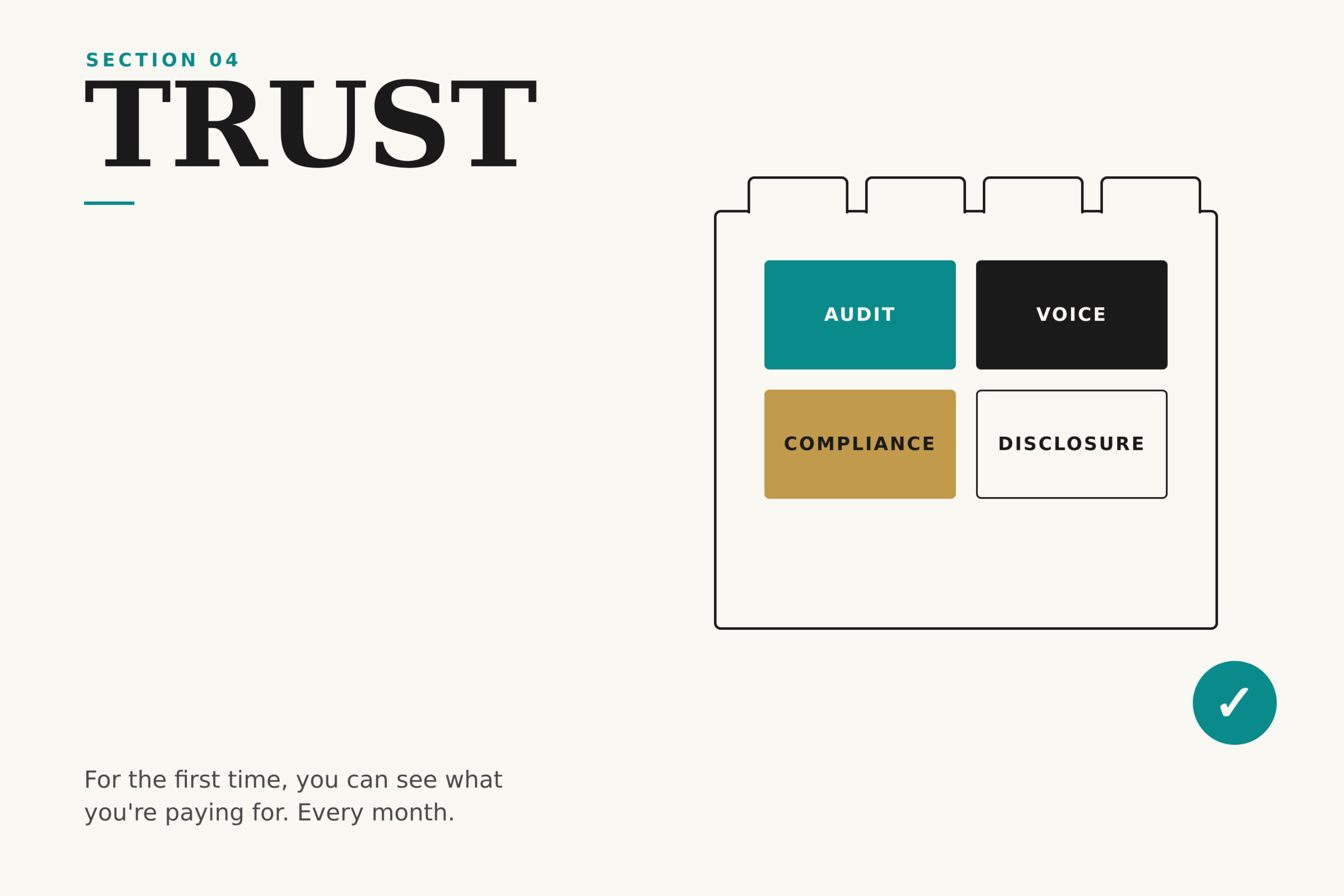
04 — TRUST
"How do I trust AI with my brand?"
You're right to ask. The difference is governance. Here's what governance looks like in practice — not as a promise, but as a process.
When everything needs compliance review
The need. An independent wealth management firm in Italian-speaking Switzerland is regulated by FINMA. Every piece of client communication — newsletter, blog post, LinkedIn update, market commentary — must comply with FINMA guidelines on advertising, risk disclosure, and client protection. The firm's compliance officer reviews every piece manually, which takes 48 hours per piece and creates a bottleneck that means content ships rarely. The partners want to increase their public visibility — a thought leadership presence on LinkedIn, a regular market commentary, a quarterly client newsletter — but the compliance review makes the cadence unsustainable. They can't produce content fast enough to be visible, and they can't skip compliance review without risking a FINMA finding. The tension between visibility and compliance is solved by doing neither.
How MarKomX answers. The Marketing Director agent builds a content architecture with compliance built into the workflow, not bolted on at the end. The copywriter agent drafts each piece using a brand-specific compliance template — mandatory risk disclosures, prohibited claims, required disclaimers — that the firm's compliance officer has approved in advance. The brand manager agent runs a pre-compliance review on every piece before it reaches the compliance officer, catching 80–90% of potential issues (the ones that are about tone, framing, or standard disclosure placement). The compliance officer's review time drops from 48 hours to 30 minutes — they're reviewing for substance, not for formatting. The Marketing Director tracks the review chain: draft → brand review → compliance review → approval → publication. Every step is logged. Every piece is archived.
The outcome. The firm ships a monthly newsletter, a fortnightly market commentary, and a weekly LinkedIn post — all compliance-reviewed, all archived, all within FINMA guidelines. The compliance officer's review time drops from 48 hours per piece to 30 minutes. The partners increase their public visibility without increasing their compliance risk. The review chain is transparent — if FINMA asks "show us your content review process," the firm can produce the log for any piece in five minutes.
"Compliance wasn't the obstacle. The workflow was. MarKomX built the compliance into the workflow, and the bottleneck disappeared."
When your brand voice is inconsistent across markets
The need. A medical technology startup is launching simultaneously in Switzerland, Germany, and the UK. The marketing team is the founder (a scientist), the head of commercial (a former nurse), and an agency that writes their German content. The brand voice is different in every market: the Swiss website is precise and clinical, the German content is aggressive and sales-led, the UK content is academic and reserved. A clinician who visits the Swiss website after seeing the German LinkedIn page doesn't recognise the company. The founder is worried — not about the product, which is excellent — but about the brand. Medical professionals buy from brands they trust, and trust is built on consistency. The startup is months from launch and the brand is three different companies in three different markets.
How MarKomX answers. The brand manager agent builds a brand voice framework — a single document that defines the tone, the language rules, the prohibited phrases, the mandatory disclosures, and the positioning architecture — that applies across all three markets. The copywriter agent produces all content — Swiss German, German, English — against the same framework, with market-specific adaptation (not market-specific invention). The Marketing Director reviews every piece for brand consistency before publication and rejects anything that drifts. The external agency contract is ended — the startup now has one team producing all content against one brand voice. The art director agent produces visual guidelines that match the voice framework, ensuring the design language is consistent across markets too.
The outcome. The startup launches with one brand voice across three markets. A clinician who visits the Swiss website after seeing the German LinkedIn page recognises the company immediately. The brand consistency reduces the sales cycle — medical professionals don't spend time reconciling contradictory brand signals — and the startup's brand authority compounds across all three markets simultaneously. The founder stops worrying about the brand and goes back to the product. The brand manager agent is the guardian; the founder is the owner.
"We were three different companies in three markets. MarKomX made us one company in three languages."
YOUR USE CASE
Recognise your situation? That's where we start.
These are need-based scenarios. Your business is real. Book a 30-minute conversation — tell us which situation is closest to yours, and we'll tell you what your team would do about it. No pitch. No commitment. No template proposal.
Book a conversation →